
Death is a unifying experience. The ways communities treat this experience, and the changes to rites and customs which concern death, help reflect aspects of life. Grave goods can indicate the individual’s identity and roles within the community, as well as culture-wide phenomena, such as religion, economy, and trade. To illustrate how grave goods can help us reconstruct the past, the following examples will focus on Bronze Age Aegean societies to compare assemblages and the ways they both answer and pose new questions.
As a starting point, grave goods can give an idea of the individual identity of the dead. Their occupation, gender, and social standing are three major qualities that are reflected in burials. The undisturbed grave of the “Griffin Warrior”, in Pylos, provides valuable evidence as to what an untouched elite burial looks like1 for Mycenaean culture, and is an excellent case study for reconstructing what his identity may have been in life.
The Warrior’s grave contained hundreds of fine goods, such as jewelry, a horned bull staff, and weaponry.2 The quantity and quality of items denotes an elite status – the man likely had a high standing in his community. The weaponry included a finely wrought sword, armour, and a boar-tusk helmet. These items imply a role in warfare (an esteemed occupation for the martial-minded Mycenaeans), but there may be some overlap between the functional and symbolic.3 The sword has a very delicate gold-work style that is shared across other seats of Mycenaean power.4 When observing evidence in context, could the weapons be for ceremonial purposes, rather than combat?
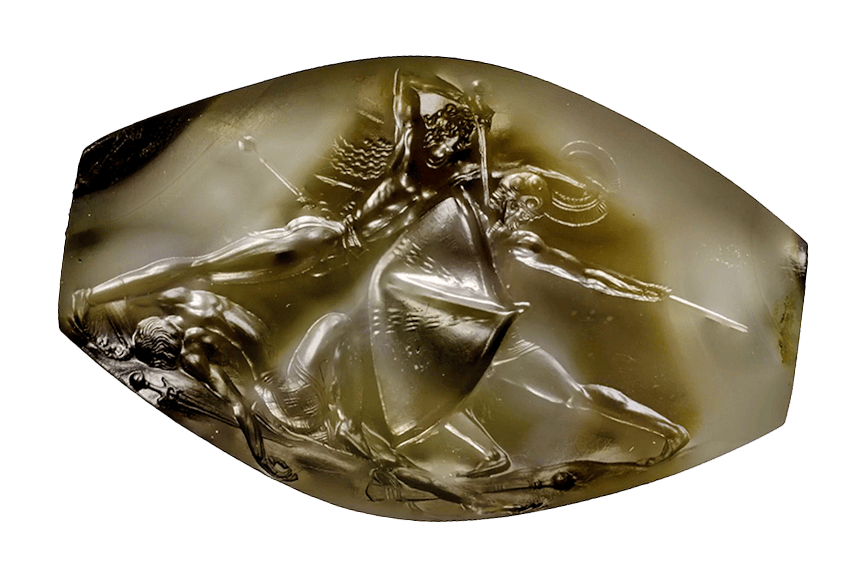
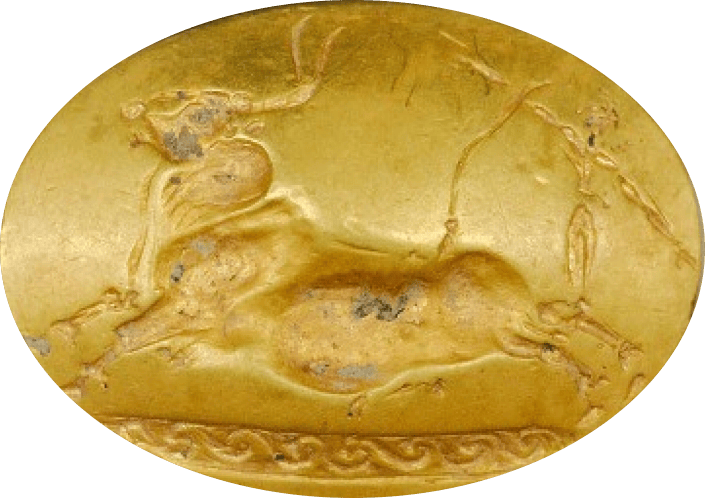
To support questions like these, grave goods can be seen as an assemblage of items, rather than as isolated individual artefacts, helping reveal their relationships to each other and the larger picture.5 In the Griffin Warrior’s case, a collection of gold signet rings were also found bearing Minoan style motifs. Seal stones and signet rings were often used in powerful administrative roles, cataloguing the management of palatial centres.6 We can contextualise these artefacts with what we know of Minoan horn and bull iconography,7 its presence in the signet rings, and the continuation of that motif in the horned bull staff present in the warrior’s grave. This presents a new question. Is that combination of artefacts meant to convey the man held a leadership position that went beyond the role of warrior? Ultimately, although grave goods help paint a picture of what life may have been like, they cannot give us a decisive answer.
The Griffin Warrior’s body was identified as male, but if his remains had been too damaged to sex, burial goods would still be useful in establishing a likely gender. As a rough rule of thumb, Bronze Age male burials (especially elite ones) tend to contain more items pertaining to the social and economic spheres, while female burials tend to reflect the domestic sphere.8 Where the remains cannot be reliably sexed, an archaeologist can make an informed decision by the kinds of objects included, and comparing to similar burials of the culture. For example, a loom weight would most likely be part of a female grave, since textile work was primarily carried out by women.9 Some Mycenaean female graves were more overt and included kourotrophos, small clay idols that showed a mother and child, and highlighted the role of childrearing.10
That being said, gender roles are not universal nor set in stone, with earlier Minoan examples showing women in more visibly powerful roles than men.11 The female Tholos grave found in Archanes12 included luxury goods and gold signet rings. This grave also included sacrifices of valuable livestock in the form of oxen and horses, a rich assemblage not wholly dissimilar to the Griffin Warrior. These exceptions do not prove the rule. Instead, they remind us not to project our biases or preconceptions onto notions of gender roles in prehistory.
Broadening the scope to community-wide characteristics, grave goods can reflect societally-held beliefs and identities.13 Spiritual beliefs surrounding death and the afterlife, for example, can be reconstructed when artefacts include a representation of the burial rites themselves. One example of this is the Hagia Triada sarcophagus, from a Bronze Age late Minoan burial on Crete. Known as a larnax, the coffin was painted in a fresco depiction of the extravagant procession that led to the dead man’s burial, who is himself depicted standing in front of his own tomb.14
From this one artifact, we can infer the kinds of animals and iconography involved in ritual practice, the different roles men and women played in the procession, their fashions, the kinds of libations, foods, and musical instruments involved. A lot of these elements, like the clothing and instruments, would not be as easily preserved as the clay, and so the depiction on the coffin is even more important in enlightening the overlap between Minoan and Mycenaean cultures at the time.
More abstract questions about spiritual beliefs can be posed too. The dead man is portrayed as standing – was the spirit believed to still be present, having not immediately passed on to the afterlife? What does that imply about changing beliefs when compared to similar artefacts from different times? For instance, the monumental grave markers of the Greek Archaic period showed the dead man lying on a bier,15 taking a less active role as the rites took place.
Beyond the spiritual, burials also provide evidence for ethnicity, economics and trade. Grave goods, along with burial styles, were one way for people to reinforce their ethnic identities and connections to the land. The differences in clay figurines for example across mainland Greece varied village to village reflecting local differences, and rejecting the idea of a homogenous Mycenaean ethnic identity.16 By burying extravagant offerings, “the wealth deposited with the dead was effectively destroyed for the living and taken out of circulation” (Shelmerdine, 2008, p.337). They could afford to bury these goods. The grave circles of Mycenae likely contain as much wealth as they do since Mycenae was itself a seat of power in the region.17
Burial goods that have been acquired through trade stand out as indicative of connections and reputation, such as the Egyptian items found in tombs in southern Crete.18 Cross-referencing these goods with Egyptian archaeological records helps establish a date for the Cretan burials. Conversely, Theban tombs contain illustrations of an Aegean procession bearing gifts.19 Both sets of tombs establish that Crete was not only involved in maritime trade, but their exports would have been considered desirable to pharaohs during a period of incredible wealth for Egypt.20

Beyond trade, conquest also leads to artefact overlap. When Cretan palatial centres underwent significant damage in the late Minoan period, Mycenaean style warrior graves began to crop up on the island.21 Along with other key pieces of evidence, it suggests mainland culture became the dominant power on Crete, albeit still incorporating many Minoan visual styles into their own.22
There are elements to keep in mind when interpreting burial goods as evidence. Looting, decomposition, and survivorship bias, can all affect how we reconstruct the past, and must be taken into account when excavating and understanding burial sites. The enigmatic nature of Cycladic Figurines is due in part to the extensive looting suffered by burial sites at the hands of collectors, and valuable context was lost.23 Many times richer burials are more visible than poorer graves, skewing the kind of people we would have data on. Interpretative bias is another element, and as Stephanie Moser writes, “every picture of the past is an artefact of the present and will embody modern concepts”.24 Ultimately, when properly excavated and through careful interpretation, grave goods are key pieces of the puzzle when attempting to reconstruct past societies, especially ones where other records are lost to time.
This is the second assignment I wrote for the course Archaeology in Practice, this time focusing on how grave goods help us reconstruct the past.
Images are the Pylos Combat Agate, a gold Bull-Leaping Sealstone, and a facsimile by Nina de Garis Davies of the Gifts from Keftiu, from the Tomb of Rekhmire.
- Curry, Andrew, World of the Griffin Warrior (2019) <https://archaeology.org/issues/september-october-2019/features/greece-pylos-mycenaean-warrior-grave/ > [accessed 27 March 2025]. ↩︎
- Davis, Jack L. and Stocker, Sharon R., ‘The Lord of the Gold Rings: The Griffin Warrior of Pylos’, Hesperia: The Journal of the American School of Classical Studies at Athens, 85 (2016), pp. 627-630 <https://doi.org/10.2972/hesperia.85.4.0627> [accessed 27 March 2025]. ↩︎
- Cavanagh, William, ‘Death and the Mycenaeans’, in The Cambridge Companion to the Aegean Bronze Age, by C.W. Shelmerdine (New York: Cambridge University Press, 2008), p. 335. ↩︎
- Davis and Stocker, ‘The Lord of the Gold Rings’, p. 634. ↩︎
- Greene, Kevin and Moore, Tom, Archaeology: An Introduction (Abingdon: Routledge, 2010), p. 138. ↩︎
- Webb, Jennifer M. and Weingarten, Judith, ‘Seals and seal use: markers of social, political and economic transformations on two islands’, British School at Athens Studies, 20 (2012), p. 94 <https://www.jstor.org/stable/23541203> [accessed 27 March 2025]. ↩︎
- Banou, Emilia, ‘Minoan ‘Horns of Consecration’ Revisited: A Symbol of Sun Worship in Palatial and Post-Palatial Crete?’, Mediterranean Archaeology and Archaeometry, 8.1 (2008), p. 31. ↩︎
- D’Agata, Anna L., ‘Funerary Practices, Female Identities, and the Clay Pyxis in Late Minoan III Crete’ in Death in Late Bronze Age Greece, ed. by J.M.A. Murphy (New York: Oxford University Press, 2020), p. 302 <doi:10.1093/oso/9780190619305.003.0014> [accessed 27 March 2025]. ↩︎
- Olsen, Barbara A., ‘The Worlds of Penelope: Women in the Mycenaean and Homeric Economies’, Arethusa, 48 (2015), p. 113 <https://www.jstor.org/stable/26314618> [accessed 27 March 2025]. ↩︎
- Nikolaidou, Marianna, ‘Looking for Minoan and Mycenaean Women: Paths of Feminist Scholarship Towards the Aegean Bronze Age’ in A Companion to Women in the Ancient World, ed. by S.L. James and S. Dillon (Blackwell Publishing Ltd., 2012), p. 48. ↩︎
- Younger, John B. and Rehak, Paul, ‘Minoan Culture: Religion, Burial Customs, and Administration’ in The Cambridge Companion to the Aegean Bronze Age, by C.W. Shelmerdine (New York: Cambridge University Press, 2008), p. 180. ↩︎
- Nikolaidou, ‘Looking for Minoan and Mycenaean Women’, in A Companion to Women in the Ancient World, p. 42. ↩︎
- Cavanagh, ‘Death and the Mycenaeans’, in The Cambridge Companion to the Aegean Bronze Age, p.330. ↩︎
- Heraklion Museum, Hagia Triada, Necropolis, Tomb 4. 1370-1320 BC (2022). <https://heraklionmuseum.gr/en/exhibit/the-hagia-triada-sarcophagus/> [accessed 27 March 2025]. ↩︎
- The Metropolitan Museum of Art, Terracotta krater (2019). <https://www.metmuseum.org/art/collection/search/248904> [accessed 27 March 2025]. ↩︎
- Cavanagh, ‘Death and the Mycenaeans’, in The Cambridge Companion to the Aegean Bronze Age, pp. 332-333. ↩︎
- Encyclopedia Britannica, Mycenae. <https://www.britannica.com/place/Mycenae> [accessed 28 March 2025]. ↩︎
- Betancourt, Philip P., ‘Minoan Trade’, in The Cambridge Companion to the Aegean Bronze Age, by C.W. Shelmerdine (New York: Cambridge University Press, 2008), p. 216. ↩︎
- Younger, and Rehak, ‘Minoan Culture’ in The Cambridge Companion to the Aegean Bronze Age, p. 157 ↩︎
- Bedoyere, Guy, How Egypt Became One of the World’s Richest Nations During the 18th Dynasty, (2023) <https://bigthink.com/the-past/egypt-pharaohs-of-the-sun/ > [accessed: 28 March 2025]. ↩︎
- Watrous, Vance L., ‘The Origin and Iconography of the Late Minoan Painted Larnax’, Hesperia: The Journal of the American School of Classical Studies at Athens, 60.3 (1991), p. 286. ↩︎
- Pomeroy, Sarah B. and others., A Brief History of Ancient Greece (New York: Oxford University Press, 2015), p.26. ↩︎
- The Hunt Museum, Cycladic Marble Figurine (2024). <https://www.huntmuseum.com/stories/objects-in-focus/cycladic-marble-figurine/> [accessed 28 March 2025]. ↩︎
- Moser, S., ‘Ancestral Images: The Iconography of Human Origins’ (New York: Cornell University Press, 1998), in Greene and Moore, Archaeology: An Introduction, p. 289. ↩︎
Bibliography
Alekshin, V.A. and others., ‘Burial Customs as an Archaeological Source’, Current Anthropology, 24.2 (1983), 137-149 <https://www.jstor.org/stable/2742572> [accessed 13 March 2025].
Banou, Emilia, ‘Minoan ‘Horns of Consecration’ Revisited: A Symbol of Sun Worship in Palatial and Post-Palatial Crete?’, Mediterranean Archaeology and Archaeometry, 8.1 (2008), pp. 27-47.
Bedoyere, Guy, How Egypt Became One of the World’s Richest Nations During the 18th Dynasty, (2023) <https://bigthink.com/the-past/egypt-pharaohs-of-the-sun/ > [accessed: 28 March 2025].
Cavanagh, William, ‘Death and the Mycenaeans’, in The Cambridge Companion to the Aegean Bronze Age, by C.W. Shelmerdine (New York: Cambridge University Press, 2008), pp. 327-341.
Curry, Andrew, World of the Griffin Warrior (2019) <https://archaeology.org/issues/september-october-2019/features/greece-pylos-mycenaean-warrior-grave/ > [accessed 27 March 2025].
D’Agata, Anna L., ‘Funerary Practices, Female Identities, and the Clay Pyxis in Late Minoan III Crete’ in Death in Late Bronze Age Greece, ed. by J.M.A. Murphy (New York: Oxford University Press, 2020), pp. 300-319 <doi:10.1093/oso/9780190619305.003.0014> [accessed 27 March 2025].
David, Amanda L., ‘Egyptian and Minoan Relations during the Eighteenth Dynasty/Late Bronze Age’ (unpublished doctoral thesis, Brown University, 2016).
Davis, Jack L. and Stocker, Sharon R., ‘The Lord of the Gold Rings: The Griffin Warrior of Pylos’, Hesperia: The Journal of the American School of Classical Studies at Athens, 85.4 (2016), pp. 627-655 <https://doi.org/10.2972/hesperia.85.4.0627> [accessed 27 March 2025].
Greene, Kevin and Moore, Tom, Archaeology: An Introduction (Abingdon: Routledge, 2010).
The Hunt Museum, Cycladic Marble Figurine (2024). <https://www.huntmuseum.com/stories/objects-in-focus/cycladic-marble-figurine/> [accessed 28 March 2025].
Nikolaidou, Marianna, ‘Looking for Minoan and Mycenaean Women: Paths of Feminist Scholarship Towards the Aegean Bronze Age’ in A Companion to Women in the Ancient World, ed. by S.L. James and S. Dillon (Blackwell Publishing Ltd., 2012), pp. 38-53.
Olsen, Barbara A., ‘The Worlds of Penelope: Women in the Mycenaean and Homeric Economies’, Arethusa, 48 (2015), pp. 107-138 <https://www.jstor.org/stable/26314618> [accessed 27 March 2025].
Pomeroy, Sarah B. and others., A Brief History of Ancient Greece (New York: Oxford University Press, 2015).
Watrous, Vance L., ‘The Origin and Iconography of the Late Minoan Painted Larnax’, Hesperia: The Journal of the American School of Classical Studies at Athens, 60.3 (1991), pp. 285-307.
Webb, Jennifer M. and Weingarten, Judith, ‘Seals and seal use: markers of social, political and economic transformations on two islands’, British School at Athens Studies, 20 (2012), pp. 85-104 <https://www.jstor.org/stable/23541203> [accessed 27 March 2025].
Younger, John B. and Rehak, Paul, ‘Minoan Culture: Religion, Burial Customs, and Administration’ in The Cambridge Companion to the Aegean Bronze Age, by C.W. Shelmerdine (New York: Cambridge University Press, 2008), pp. 165-185.


Leave a Reply