
When the Neopalatial Period on Crete came to a close in the destructions of Late Minoan IB, art and culture shifted in unprecedented ways.1 Previously Minoan material goods began to reflect mainland Mycenaean tastes. One motif which persisted through change was the octopus.
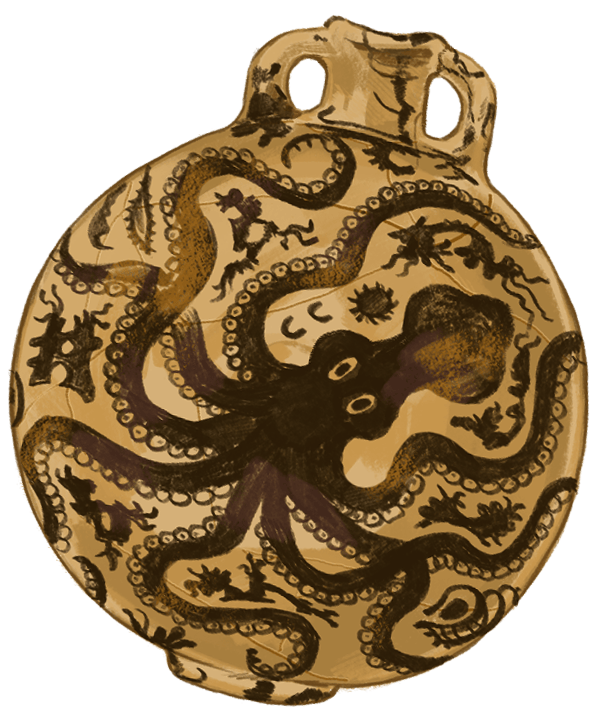
By comparing Neopalatial pottery styles of octopi with their later Palatial Style equivalents, the ‘Octopus Test’ suggests that the dominant Minoan power over the Aegean gave way to Mycenaean control.
The octopus is a useful frame of reference, as it is a consistent motif before and after the destructions. The Neopalatial octopus follows Minoan style conventions of naturalism and abundance. The Final Palatial equivalent instead follows mainland conventions, favouring abstraction and simplicity. Interrogating its meaning as a motif sheds light on the purpose of octopus vessels, while analysis of stylistic changes functions as a litmus test to distinguish between Minoan and Mycenaean periods of power. 2
However, using the Octopus Test as a definitive measure of culture has drawbacks. Attempting to distil the past into neat boxes of ‘Minoan’ and ‘Mycenaean’ may be misguided – history is rarely clear-cut. Instead, the octopus is a more useful tool in demonstrating the crossover of cultures, the roles of shared iconography and understanding the nuanced development of Crete as its administration evolved.
Firstly, the octopus’s iconographic role raises interesting questions. Marine scenes may have celebrated the resources the sea provided, but the octopus’ importance stands out. Where other themes were lost in the Final Palatial period,3 the cephalopod was carried forward with new contexts. It is present in luxury ceramics for both Minoans and Mycenaeans. These items would have been traded, gifted and represented their culture abroad.4 A painted octopus is found on the floor of the palace of Pylos, in a place of honour beneath the hearth. Elite burials on the mainland saw gold cups and garment appliques featuring octopi as well.5 Was the octopus a “cultural emblem”?6 Did it represent qualities both Minoan and Mycenaean elites identified with? Could it have symbolised a celebration of power and wealth as accessed through impressive seafaring and trade? Did its meaning change along with its style?
To establish context, we must define the two styles the octopus appears in. The Neopalatial style spans from c.1540-1450 BCE. Within this category, the Marine Style brought detailed seascapes to life: entire surfaces of vessels were filled with dynamic scenes of octopi, dolphins, coral, and fish. Ceramic goods, like the Palaikastro Octopus flask,7 were produced primarily in palatial workshops for elite use and luxury trade.8 The themes featured on vessels like these can be interpreted to portray wealth, power, and prestige – representative of the elite groups which used them.9 This style seemingly came to an end with the LM IB destruction and abandonment of administrative sites on Crete – sparing Knossos.
Unlike the previous destructions of Middle Minoan II,10 the LM IB destructions saw a major cultural shift on the island. Lost were the lustral basins, enigmatic women in power, and women in nature.11 Linear B replaced Linear A as the language of administration, and traditional Minoan art and architectural forms were adapted for mainland traditions. These favoured themes of martial power, hunting, and processions. A key piece of evidence that followed was the difference in burials, with Mycenaean-style “Warrior Graves” making an appearance on Crete.12 Crete became “as thoroughly ‘Mycenaean’ in their material culture as they had once been Minoan” (Shelmerdine, 2008, p. 206). The octopus krater from LH IIIA2, found in Rhodes,13 is a fantastic example of the abstraction and simplicity of the Palatial Style of this period. The octopus no longer swims surrounded by sea life, but is arranged still and stiff in an otherwise empty space.
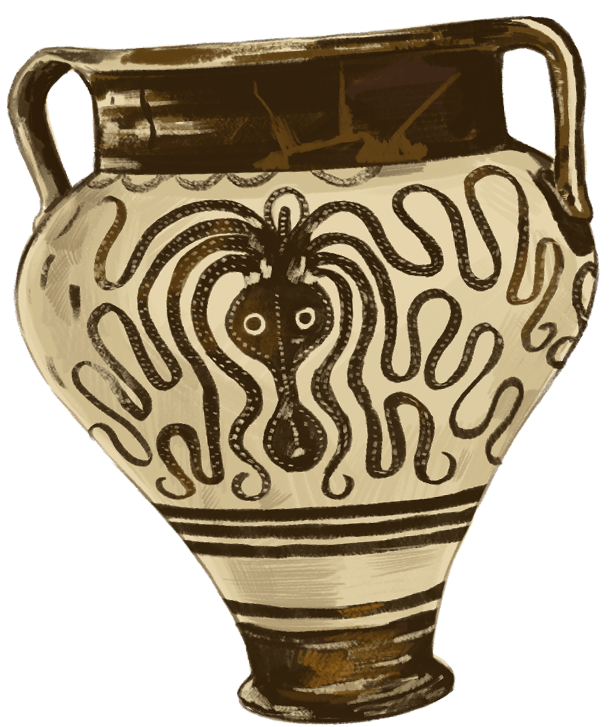
This dramatic visual change is one piece of the puzzle in the development of a new dominant culture in the Aegean. There is no definite cause for the destructions, but these changes may point towards mainland involvement or opportunism. Whether as the instigating conquerors or foreign aid to a Knossian takeover,14 the Mycenaean influence catalysed a visual shift in what was produced, consumed, and emulated by the elite of Crete and the mainland. The evidence may point to a radical change in culture, but the reality is more nuanced. Relying on the Octopus Test to delineate between purely ‘Minoan’ or ‘Mycenaean’ periods has its challenges. These challenges include our use of modern terminology, Minoan culture’s dominance in the Aegean, and the gradual cultural assimilation in LM II.
Firstly, the identities we call ‘Minoan’ or ‘Mycenaean’ are modern terms. They are unrelated to the ethnic or national identities that existed at the time. It would be ill-advised to attempt to use the octopus’ style to infer inherent ethnic differences15 (and the ways these manifest in art) between the groups of Crete and the mainland.
Secondly, Minoan influence was extensive, shaping and informing the material goods of the Aegean.16 Many direct copies of Minoan ceramics were made locally on the mainland,17 and Minoan Neopalatial iconography was adopted as a status symbol for the growing Mycenaean culture.18 This crossover complicates the provenance of ceramic goods and their meanings. One example of confusing origin is the Dendra Octopus cup. Its Minoan-styled craftsmanship, yet likely Mycenaean origin, demonstrates the cultures are so intertwined that “traditional methods of distinguishing style in the fifteenth century B.C. are largely inadequate” (Hurwit, 1979, p. 413).
Cultural overlap went beyond the visual arts. Rehak and Younger (1998, p. 139) propose the possibility of Mycenaean presence in Knossos before the LM IB destructions. Final Palatial Knossos saw aspects of Minoan religion and administration carried on under what we identify as Mycenaean rule, both on Crete and the mainland. Knossos may have taken on more of a “mercantile”19 administrative role than it may have fulfilled in the Neopalatial era, but there is evidence the new administration repurposed the existing systems of power in place.20 It is important to keep in mind that the seemingly sudden shift in style would have taken generations, and the blending of cultures was likely more gradual in reality. The cultural backdrop of Crete following the destructions would have been a mix of Minoan and Mycenaean elements, rather than a completely new era.
In conclusion, the enigmatic octopus motif is a good starting point for understanding the evolution of Crete’s art and culture from the Neopalatial to the Final Palatial periods. What we do know, is the dynamic swimming octopus attributed to the Minoans ceased to swim after the LM IB destructions, gradually simplifying and abstracting into a creature that mirrored mainland tastes and styles. We can infer from these stylistic changes that there was a Mycenaean influence in Crete, which became as dominant a power in the Aegean as the Minoans once were. However, we must be wary of oversimplifying history into neat categories. Crete and the mainland overlapped in shared ideology, iconography, styles, and themes, resulting in a rich tapestry of art and culture.
This was the second assignment I wrote for the Minoans and Mycenaeans short course.
The illustrations are my own! I used this image and this image as references.
- Cynthia W. Shelmerdine, The Cambridge Companion to the Aegean Bronze Age (New York:
Cambridge University Press, 2008), p. 141. ↩︎ - Donald Preziosi and Louise A. Hitchcock, Aegean Art and Architecture (Oxford: Oxford University Press, 1999), p.103. ↩︎
- Rehak, Paul and Younger, John G., ‘Review of Aegean Prehistory VII: Neopalatial, Final Palatial, and Postpalatial Crete.’ American Journal of Archaeology, 102 vols (1998), p. 149. ↩︎
- Cynthia W. Shelmerdine, The Cambridge Companion to the Aegean Bronze Age, p. 110. ↩︎
- Cartwright, M. Mycenaean Octopus Brooch (2014). World History Encyclopedia. <https://www.worldhistory.org/image/3200/mycenaean-octopus-brooch/> [accessed: 1 April 2023]. ↩︎
- Shelley J. A. Hartman, A Mycenaean Enigma: The 7-Armed Octopus from Grave Circle A. (2014), p. 4. ↩︎
- Heraklion Archaeological Museum. Collections (n.d.). <https://www.heraklionmuseum.gr/en/collections/#collections.> [accessed: 1 April 2023]. ↩︎
- Rehak and Younger, ‘Review of Aegean Prehistory VII’ p. 111.
↩︎ - Betancourt, Philip P. ‘Marine-Life Pottery from the Aegean.’ Archaeology, 30 vols (1977), p. 40. ↩︎
- Rehak and Younger, ‘Review of Aegean Prehistory VII’ p. 100. ↩︎
- Ibid., p. 149. ↩︎
- Dartmouth. Aegean Prehistoric Archaeology (n.d) <https://sites.dartmouth.edu/aegean-prehistory/lessons/lesson-18-narrative/#L189b> [accessed 1 April 2023]. ↩︎
- The British Museum. krater | British Museum (n.d.). <https://www.britishmuseum.org/collection/object/G_1959-1104-1> [accessed: 1 April 2023]. ↩︎
- Rehak and Younger, ‘Review of Aegean Prehistory VII’ p. 139. ↩︎
- Donald Preziosi and Louise A. Hitchcock, Aegean Art and Architecture, p. 10. ↩︎
- Cynthia W. Shelmerdine, The Cambridge Companion to the Aegean Bronze Age, p. 202. ↩︎
- P. A. Mountjoy, ‘A Note on the LM IB Marine Style at Knossos’ The Annual of the British School at Athens, 69 vols (1974), p. 73. ↩︎
- Rehak and Younger, ‘Review of Aegean Prehistory VII’ p. 137. ↩︎
- Donald Preziosi and Louise A. Hitchcock, Aegean Art and Architecture, p. 165. ↩︎
- Rehak and Younger, ‘Review of Aegean Prehistory VII’ p. 161. ↩︎
Bibliography
Betancourt, Philip P., ‘Marine-Life Pottery from the Aegean.’ Archaeology, 30 vols (1977) I, pp. 38-43. JSTOR, <http://www.jstor.org/stable/41706106.> [accessed: 27 March 2023].
Cartwright, M. Mycenaean Octopus Brooch (2014). World History Encyclopedia. <https://www.worldhistory.org/image/3200/mycenaean-octopus-brooch/> [accessed: 1 April 2023].
Dartmouth. Aegean Prehistoric Archaeology (n.d) <https://sites.dartmouth.edu/aegean-prehistory/lessons/lesson-18-narrative/#L189b> [accessed 1 April 2023]
Heraklion Archaeological Museum, Flask with octopus and seabed in the Marine Style (2023). <https://ca.heraklionmuseum.gr/ca/pawtucket/index.php/Detail/objects/238> [accessed: 1 April 2023].
Hurwit, Jeffrey, ‘The Dendra Octopus Cup and the Problem of Style in the Fifteenth Century Aegean.’ American Journal of Archaeology, 84 vols (University of Chicago, 1979), IV, pp. 413-26. JSTOR, <https://doi.org/10.2307/504141> [accessed: 27 Marrch 2023].
Mountjoy, P. A., ‘A Note on the LM IB Marine Style at Knossos.’ The Annual of the British School at Athens, 69 vols (1974) pp. 173–75. JSTOR, <http://www.jstor.org/stable/30103297> [accessed: 27 March 2023].
Mountjoy, P.A. and M.J. Ponting, ‘The Minoan Thalassocracy Reconsidered: Provenance Studies of LH II A/LM I B Pottery from Phylakopi, Ay. Irini and Athens.’ The Annual of the British School at Athens, 95 vols (2000) pp. 1141-84. JSTOR, <http://www.jstor.org/stable/30103430> [accessed: 27 March 2023].
Popham, Mervyn, ‘Late Minoan Pottery, a Summary.’ The Annual of the British School at Athens, 62 vols (1967) pp. 337-51. JSTOR, <http://www.jstor.org/stable/30103688> [accessed: 27 March 2023].
Preziosi, Donald and Louise A. Hitchcock, Aegean Art and Architecture (Oxford: Oxford
University Press, 1999).
Rehak, Paul and Younger, John G., ‘Review of Aegean Prehistory VII: Neopalatial, Final Palatial, and Postpalatial Crete.’ American Journal of Archaeology, 102 vols (Archaeological Institute of America, 1998), I, pp. 91–173. JSTOR, <https://doi.org/10.2307/506138> [accessed: 27 March 2023] .
Shelley J. A. Hartman, ‘A Mycenaean Enigma: The 7-Armed Octopus from Grave Circle A’, unpublished paper delivered at the ‘CAA Conference’ (London, ON, 15 May 2014).
Shelmerdine, Cynthia W., The Cambridge Companion to the Aegean Bronze Age (New York: Cambridge University Press, 2008).
Symeonoglou, Sarantis, ‘A Chart of Mycenaean and Late Minoan Pottery.’ American Journal of Archaeology, 74 vols (1970) III, pp. 285-88. JSTOR, <https://doi.org/10.2307/503103.> [accessed: 27 March 2023].
The British Museum. krater | British Museum (n.d.). <https://www.britishmuseum.org/collection/object/G_1959-1104-1> [accessed 1 April 2023].
Van de Moortel, Aleydis, Labyrinth Revisited: Rethinking ‘Minoan’ Archaeology (Kiribati: Oxbow, 2002) pp. 190-207.
Van Wijngaarden, G.J., Use and Appreciation of Mycenaean Pottery in the Levant, Cyprus and Italy (1600-1200BC) (Netherlands: Amsterdam University Press, 2002)


Leave a Reply