
This Middle Minoan ewer is a beautiful example of Kamares ware used at the palace of Phaistos, near the end of the First Palace Period. Dating to around 1750-1700 BC, it provides insight into the kinds of cultures developing at this time.
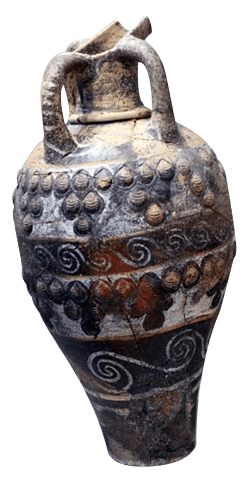
The ewer was found in room LV, in the southwest of the Old Palace of Phaistos.1 Standing at 59cm tall, it has three handles connecting the spout to the body and is decorated in the iconic polychrome Kamares style. Relief seashells sit in two alternating bands, arranged symmetrically. Separating the bands of shells are white geometric swirls, which look like waves. The large jug gives the impression of a barnacle-encrusted rock, calling to mind the natural scenes of the Mesara bay, not far from the Palace.
Marine motifs appear regularly in Minoan art. They may reflect Cretan interests in the sea as a source of resources and as the main conduit that made Minoan expansion possible. Luxury goods were exported to the Aegean and beyond, solidifying Crete as a key player in trade for the periods to come.2 Interestingly, Phaistos may not have had as prominent a role in sea trade as other centres,3 yet the marine imagery is still represented here.
The Heraklion Museum states the ewer was found alongside other items: a beaked jug, a fruit stand, and a footed krater. All share the same style and are likely part of the same set. They may have been used in communal eating and drinking ceremonies, with religious and social significance.4 The ewer was used to hold and serve liquids- could its three handles have allowed two people to pour from it together, a shared act to set it apart from smaller jugs?
Communal consumption (and the luxury goods tied to it) also provided opportunities for social competition amongst elite groups and important sites.5 At Knossos, for example, ceramics like the ewer “were used to symbolize status and convey ritual meaning […] bolstering and legitimating the power of ruling elites,” (Wilson, 1998, p.356). The palatial centres share similar design principles and may have fulfilled similar roles in their communities.6 Would luxury pottery have served a similar role at Phaistos?
Considering the above, this three-handled ewer exemplifies the pottery style of the Middle Minoan Period. It reflects the cultural practices which led to the establishment of shared ideology, the roles of the first palatial centres, and the emerging social groups on the island.
This brief commentary on a Cretan ewer’s marine motifs was my first assigment for the Minoans and Mycenaeans short course.
Imagery credit: Ewer, MM II, Phaistos. Herakleion Archaeological Museum. Photo © S. Kershaw
- Doro Levi, The Recent Excavations at Phaistos, 11 vols (Lund: Carl Bloms Boktryckeri, 1964), XI, p.7. ↩︎
- Cynthia W. Shelmerdine, The Cambridge Companion to the Aegean Bronze Age (New York: Cambridge University Press, 2008), p. 110. ↩︎
- Eric H. Cline, The Oxford Handbook of the Bronze Age Aegean (New York: Oxford University Press, 2019), p. 704. ↩︎
- Heraklion Archaeological Museum (2023). ↩︎
- Shelmerdine, The Cambridge Companion to the Aegean Bronze Age, p. 110. ↩︎
- D. Preziosi and L.A Hitchcock, Aegean Art and Architecture (Oxford: Oxford University Press, 1999), p.69. ↩︎
Bibliography
Brouwers, Josho, The Palace at Phaistos: Controlling the Messara Plain (2019), <https://www.joshobrouwers.com/articles/palace-phaistos-controlling-messara-plain/> [accessed: 28 February 2023].
Caloi, Ilaria, ‘Breaking with Tradition? The Adoption of the Wheel-Throwing Technique at Protopalatial Phaistos: Combining Macroscopic Analysis, Experimental Archaeology and Contextual Information’, Annuario della Scuola Archeologica di Atene e delle Missioni Italiane in Oriente, 97 vols (Sesto Fiorentino: All’Insegna del Giglio, 2019), XCVII, p. 9. Google Books ebook.
Cline, Eric H., The Oxford Handbook of the Bronze Age Aegean (New York: Oxford University Press, 2019).
Davaras, Costis, Phaistos: Hagia Triada-Gortyn (Athens: Editions Hannibal, 1980) <https://www.academia.edu/37051035/Phaistos_Hagia_Triada_Gortyn> [accessed: 28 February 2023].
Day, Peter M., and David Wilson, ‘Consuming Power: Kamares Ware in Protopalatial Knossos’, Antiquity, 72, (1998), 350-358.
Heraklion Archaeological Museum, Three-handled jug with relief shells and painted decoration (2023). <https://ca.heraklionmuseum.gr/ca/pawtucket/index.php/Detail/objects/98> [accessed: 28 February 2023].
Levi, Doro, The Recent Excavations at Phaistos, 11 vols (Lund: Carl Bloms Boktryckeri, 1964), XI.
Preziosi, Donald and Louise A. Hitchcock, Aegean Art and Architecture (Oxford: Oxford University Press, 1999).
Rutter, Jeremy B, Aegean Prehistoric Archaeology, Lesson 10: Narrative (2023), <https://sites.dartmouth.edu/aegean-prehistory/lessons/lesson-10-narrative/> [accessed 28 February 2023].
Shelmerdine, Cynthia W., The Cambridge Companion to the Aegean Bronze Age (New York: Cambridge University Press, 2008).
 sing-muse.com
Leave a comment